Habits, without the streaks.
A streak counts how long you've kept going, and makes missing one day feel like losing everything. Jamaal doesn't count them. It shows you a grid of days instead, and a quiet week is just a lighter-coloured row.
Four kinds of habit
When you make a habit, you choose what question it asks each day:
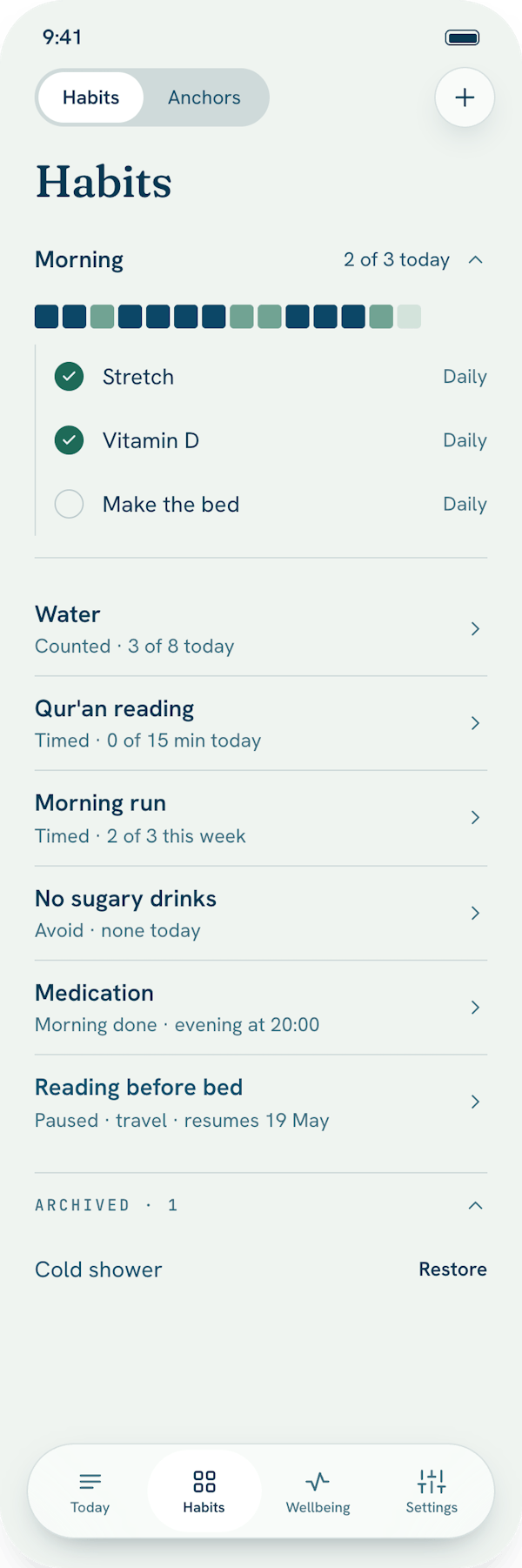
- Did I do it? Done or not. Good for things like taking a vitamin or making the bed.
- Did I do it a number of times? A counted habit: glasses of water, pages, rounds of dhikr. You tap to add one.
- Did I do it for a number of minutes? A timed habit, like reading or a run. You can start a timer, or add the minutes by hand if you did it without your phone.
- Did I avoid it? For something you're trying not to do. You only log the day you slipped, and nothing else.
A habit can have presets to start from, such as Qur'an reading, or you can begin with a blank one.
Times of day
A habit doesn't have to happen once a day. Give it a few times of day, such as morning and evening, each with its own hours, and, if you like, its own reminder. Each one appears on Today when it's due.
The grid
Open a habit and you'll see its days as a grid. Darker squares are days you did more of it; empty ones are quiet days. There is no "streak" to protect, and a day without it is shown in a soft colour, never as an error.
Groups, and weekly targets
Habits can sit in a group, like Morning, which appears on Today as a pill. And a habit can aim for a number of times a week, such as running three times, instead of every day. It stays on Today until the week's goal is met.
When life gets in the way
You can pause a habit, with a reason: a trip, an illness, a hard season. A paused habit asks nothing of you and doesn't count against you. Pick it up again when you're ready.
Where it shows up
Habits you've done feed the Wellbeing page in words, such as "most days", and never a figure to chase. A timed habit uses the same focus timer you'd use for a task, so the minutes land in the right place.