Salah, Qur'an and dhikr: a guide for Muslims using Jamaal.
Jamaal is a planner for everyone. It was also made by a Muslim who wanted his prayers, his reading and his remembrance to sit at the centre of the day, not squeezed in around it. Here's how to set it up that way.
Why Salah is an Anchor, not a habit
Most apps would make prayer a habit to tick off and count. That never felt right. A habit is something you pace. Salah's times are set by the sun, not by you. Each prayer has a window that opens and closes whether or not you're ready, and everything else in the day has to fit around it.
That's exactly what an Anchor is in Jamaal: something your day moves around, with a window rather than a deadline. You mark a prayer as attended, and there is no streak. Jamaal will never turn your prayers into a score.
Setting up prayer times
Go to Habits → Anchors, tap +, and choose Prayer times.
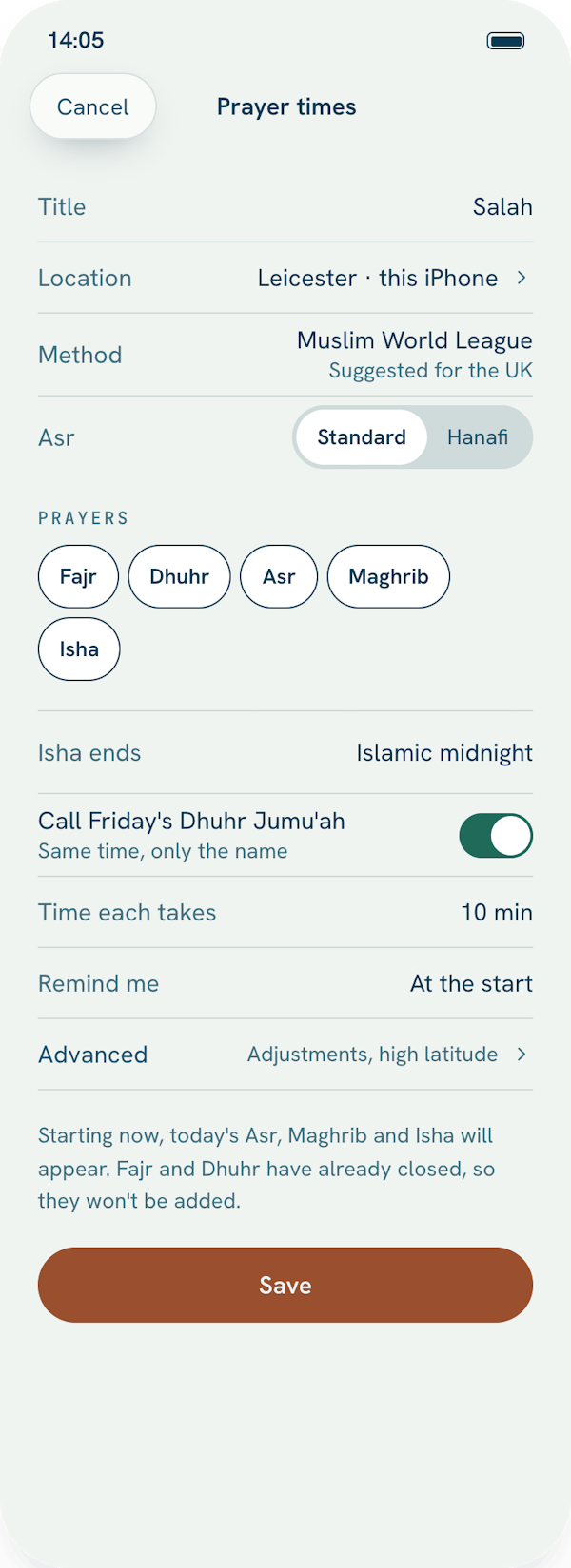
- Location
- Use your phone's location, or search for a city if you'd rather not share it.
- Method
- Jamaal suggests a calculation method for your region. Change it to match your local mosque if it differs.
- Asr
- Standard or Hanafi, depending on the school you follow.
- Isha ends
- When the Isha window closes, for example at Islamic midnight.
- Jumu'ah
- Calls Friday's Dhuhr Jumu'ah. Same window, only the name changes.
- Time each takes
- How long you set aside for each prayer, so Jamaal counts it when planning the day.
- Advanced
- Minute adjustments to match a mosque timetable, and a high-latitude rule for places where summer nights are short.
What changes in your day
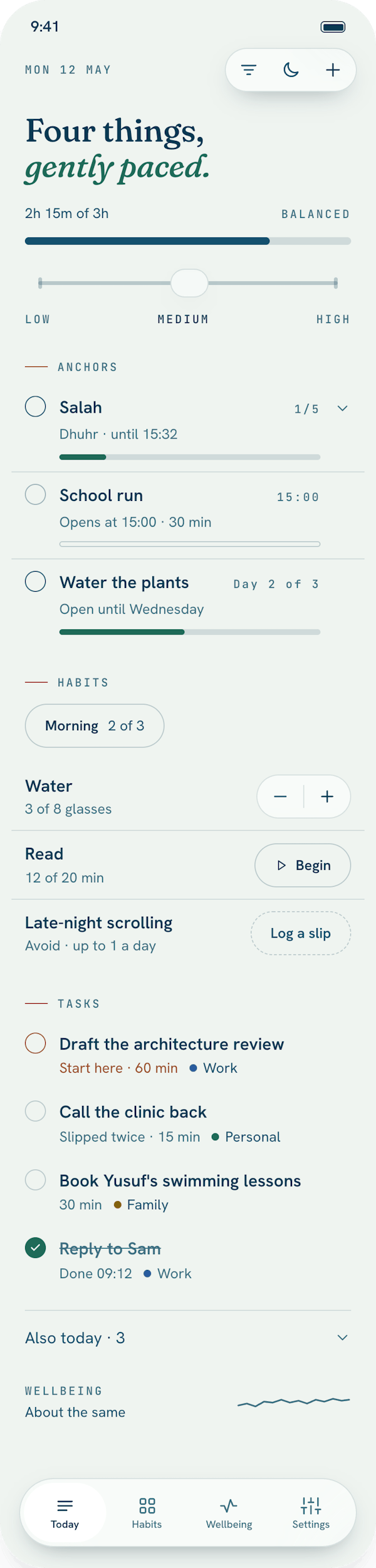
Salah appears at the top of Today as a single row. It shows the prayer that's open now, when its window closes, and how much of the window has passed. Tap it to mark the prayer attended while the window is open.
Because Jamaal knows where the windows fall, it plans around them. In the evening's Night Planning, tomorrow's free time is shown in the gaps between prayers, so a two-hour task won't be scheduled across Asr. If you're in a focus session as a window approaches, the timer gently says so, for example Maghrib in 12 min.
Qur'an: a little, every day
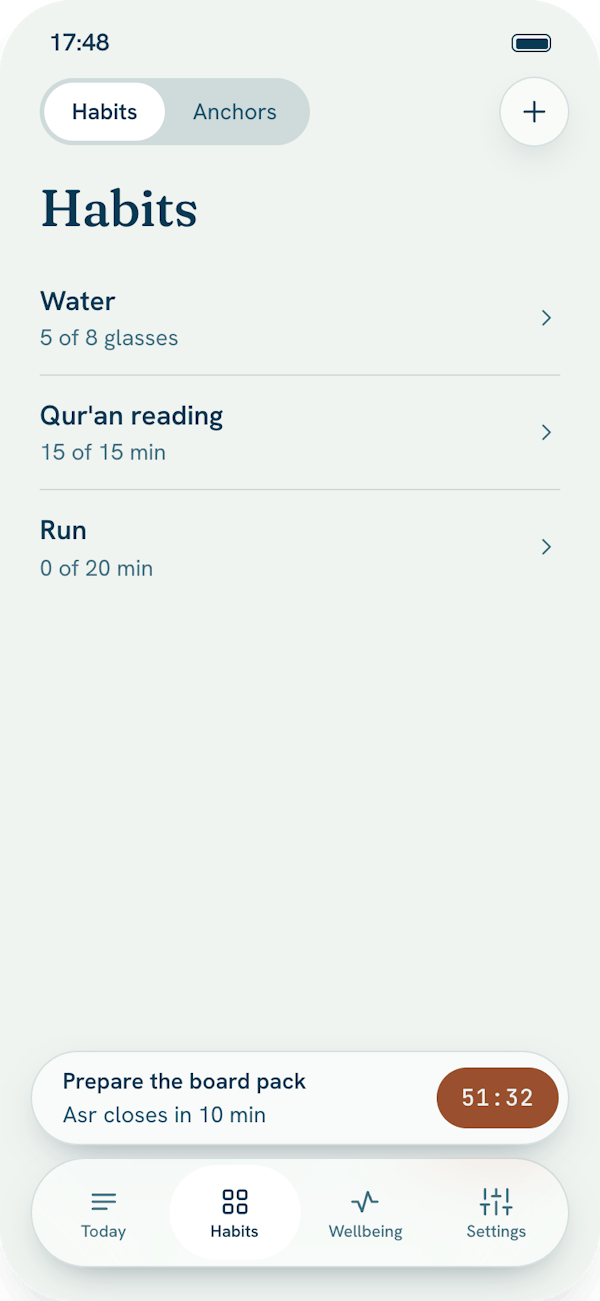
Make Qur'an reading a timed habit, such as 15 minutes a day. Tap Begin and the focus timer runs while you read. Minutes add up across the day, so a few minutes after Fajr and a few more before bed both count. If you read without the timer, you can add the minutes by hand.
The Prophet ﷺ said the deeds most beloved to Allah are the most consistent, even if they are small.
Reported by al-Bukhari and Muslim
That's why Jamaal shows habits as a grid of days, not a streak. A missed day is one pale square, and the picture you're building is steadiness over weeks. If you'd rather count pages or juz' than minutes, choose a counted habit instead.
Dhikr and the daily adhkar
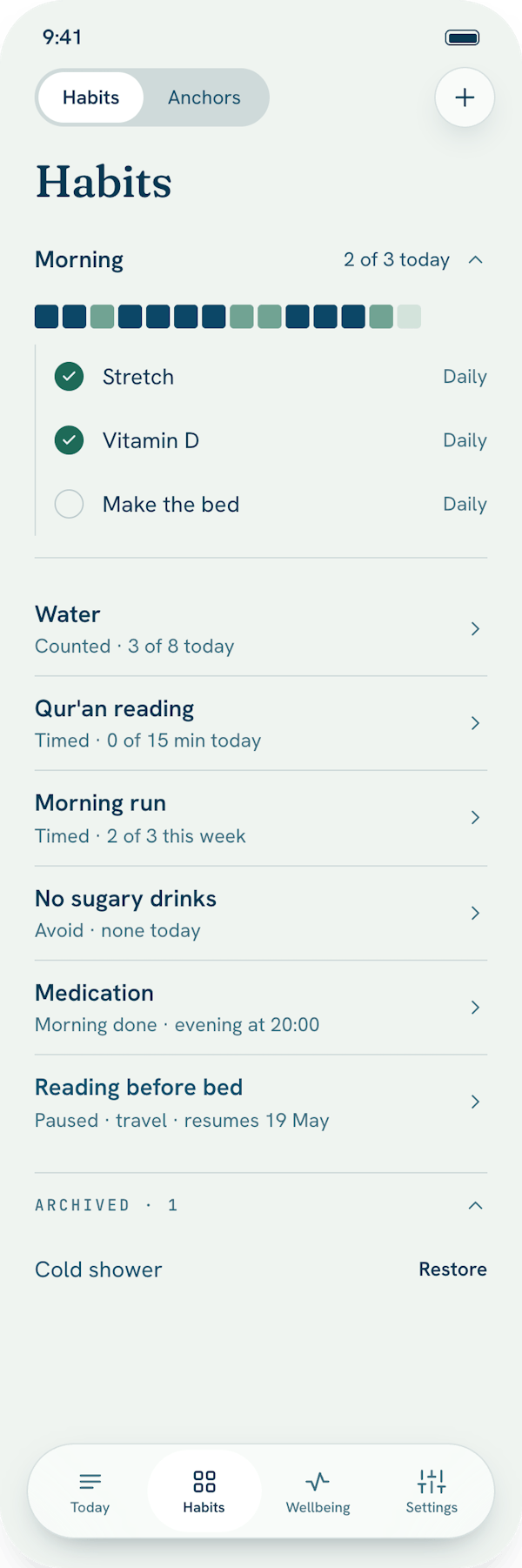
Use a counted habit for a number you aim for each day, for example 100 times SubhanAllah, and tap + as you go. For the morning and evening adhkar, add two simple daily habits and give each a time of day. Put them in a group called Morning or Evening and they appear together on Today at the right time.
Habits can have up to four times of day, each with its own optional reminder. That makes them a natural fit for anything you do after particular prayers.
Leaving things behind
Some habits are about stopping, not starting: scrolling after Isha, or backbiting. Make these avoid habits. Each day you can tap Held today, or log a slip, privately and without judgement. There's no count of days since your last slip, only a quiet picture over time.
Travel, illness and your cycle
Life changes the shape of worship. Anchors take exceptions for travel, illness or anything else, open-ended if you need them. Habits can be paused with a reason, and cycle is one of the reasons. A pause never counts against you, and the grid simply leaves those days out.
A suggested starting set
- Anchor
- Salah, all five prayers, with Jumu'ah on Fridays
- Timed habit
- Qur'an, 15 minutes a day
- Counted habit
- Dhikr, 100 a day
- Daily habits
- Morning adhkar after Fajr, evening adhkar after Asr, grouped
- Avoid habit
- Phone after Isha
Start smaller than you think you should. Jamaal is built for the steady version of you, not the ambitious one. May it make your days a little lighter.